
Most kitchen sponges hold 8–15 times their dry weight, roughly 100–200 milliliters.
Curious minds ask how much water can a sponge hold because the answer changes by material, size, and even how you squeeze it. I’ve tested dozens in real-life cleaning, lab demos, and workshop builds. In this guide, I explain what really drives capacity, how to measure it at home, and how to get the most out of any sponge without guesswork. You’ll leave knowing exactly how much water can a sponge hold for your use case, and why.

How much water can a sponge hold: a simple answer with real numbers
Most household cellulose sponges hold about 8–15 times their dry weight after a light drain. For a common 4.5 by 2.8 by 1 inch kitchen sponge, that is usually 100–200 milliliters. Natural sea sponges can exceed that, while many foam car sponges hold less unless you work them under water.
Two rules help. Weight ratio is easy to compare across brands. Volume ratio helps you plan for jobs like washing a car or mopping. In many tests, the water held is 50–85% of the sponge’s total volume after a 20–30 second drip. This is why how much water can a sponge hold will vary by sponge type and handling.

What controls a sponge’s water capacity
Several factors decide how much water can a sponge hold in practice. Small changes can double or halve what you get.
- Material chemistry. Cellulose is very hydrophilic, so it pulls in water fast. Many polyurethane foams are less so unless they are treated or fully open-celled.
- Porosity. More void space means more room for water. Typical sponge porosity runs 80–95%.
- Pore size and openness. Open, well-connected pores fill and drain better. Very fine pores hold water against gravity more tightly.
- Density. Low-density sponges can hold a lot per gram of sponge, but may collapse under load.
- Reticulation. Reticulated (fully open) foam improves flow and refill speed, but can drip more after lifting.
- Shape and size. Thick blocks trap more water per unit of footprint. Edges and cuts aid flow paths.
- Technique. Pre-wetting, squeezing under water, and gentle wringing change results a lot.
- Time and gravity. Give a sponge 30 seconds to drip, and you’ll hold less than at the instant of lift.
- Water variables. Warm water and a drop of dish soap reduce surface tension and boost uptake.
These drivers explain why how much water can a sponge hold is not one fixed number.
Typical capacities by sponge type
Below are realistic ranges I see in home and shop tests. Your exact results may differ by brand and pore size.
- Cellulose kitchen sponge. Commonly 8–15× dry weight, about 100–200 mL for mid-size pieces.
- Natural sea sponge. Often 10–20× dry weight. Many hold 150–300 mL in palm sizes.
- Polyurethane car wash sponge. Often 4–10× dry weight. Big blocks can still carry 400–900 mL due to size.
- Melamine foam (eraser sponge). About 6–12× dry weight, but fills slower and breaks down with heavy wringing.
- Cosmetic sponge/beauty blender type. Typically 3–6× dry weight depending on foam and finish.
- Scouring sponge with scrub layer. Slightly less than plain cellulose because the scrub side drains faster.
These ranges show why asking how much water can a sponge hold must include the sponge material and the test method.

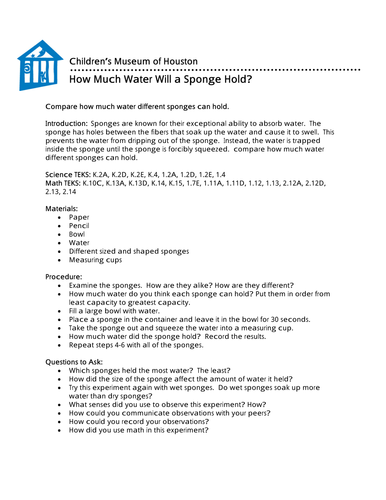
How to measure how much water your sponge can hold at home
You can answer how much water can a sponge hold for your exact sponge in minutes. No fancy tools needed.
- Tools. Kitchen scale, cup or bowl, timer, and room-temperature water.
- Step 1. Weigh the dry sponge. Note the dry weight (grams).
- Step 2. Submerge and squeeze. Compress under water 3–5 times to purge air.
- Step 3. Lift and let drip. Hold above the bowl for 20–30 seconds. Do not squeeze.
- Step 4. Weigh again. The new weight minus dry weight equals grams of water, which equals milliliters.
- Step 5. Compute ratios. Water volume divided by sponge volume gives a volume ratio. Water weight divided by dry sponge weight gives a weight ratio.
Example from my shop: A 4.5 × 2.8 × 1.0 inch cellulose sponge (about 206 cubic centimeters) weighed 18 g dry. After saturation and a 30 second drip, it weighed 190 g. It held 172 g of water, or 172 mL. That is 9.6× by weight and about 83% of its volume. A perfect snapshot of how much water can a sponge hold in daily use.

Tips to increase or control a sponge’s water uptake
Sometimes you want maximum load. Other times, you want control and less drip.
- Pre-wet and wring once. A wet sponge pulls in more water on the next dip.
- Use warm water. It flows faster into pores and can raise capacity a bit.
- Add a drop of soap. Lower surface tension helps fill micro-pores.
- Reticulate or roughen the face. Lightly scoring the surface can improve flow in tight foams.
- Squeeze cycles. Two or three full squeezes under water remove trapped air.
- For less drip. Use a finer pore sponge or give a longer controlled drip time.
These small moves change how much water can a sponge hold without buying a new sponge.

Real-world examples, mistakes to avoid, and lessons learned
In kitchen tests, cellulose outperforms most foams for pure uptake. It also releases water well during wiping. In car washing, a huge foam block looks great, but can drip fast. I switch to a wash mitt or a denser sponge to hold water longer on vertical panels.
Common mistakes I see are skipping the squeeze-under-water step and rushing the drip time. Both lead to low and inconsistent numbers. If you need repeatable results, pick one method, time your drip, and stick to it. That is how I standardize how much water can a sponge hold across brands.

Related concepts that explain sponge absorbency
Understanding the science helps you predict performance before you buy.
- Absorption vs adsorption. Absorption fills internal pores. Adsorption sticks water to the surface.
- Capillary action. Narrow pores pull water up and hold it against gravity.
- Porosity and permeability. Porosity is how much space is empty. Permeability is how easily water flows through.
- Effective saturation. The fraction of pore space that keeps water after gravity drainage.
- Density. Mass per volume of the solid skeleton, which affects strength and feel.
When you grasp these, how much water can a sponge hold stops being a guess.
Frequently Asked Questions of how much water can a sponge hold
How much water can a sponge hold compared to its size?
Most household sponges hold 50–85% of their own volume after a short drip. The exact number depends on pore size, material, and how you saturate it.
Does a bigger sponge always hold more water?
By volume, yes, but not always by ratio. Low-density or reticulated sponges can drip more, so the retained water may not scale perfectly with size.
Why do cellulose sponges seem to hold more water?
Cellulose is very hydrophilic and has fine, connected pores. That combo boosts capillary action and raises retained water after lifting.
Can warm water help a sponge hold more?
A bit. Warm water and a touch of soap reduce surface tension, so pores fill faster and drain more evenly, improving practical capacity.
How can I test how much water can a sponge hold without a scale?
Use a measuring cup. Saturate the sponge, let it drip for a set time, then squeeze into the cup and read the milliliters.
Conclusion
The true answer to how much water can a sponge hold depends on material, pore structure, and method. Cellulose kitchen sponges often reach 8–15× by weight, while sea sponges can go higher and many foams sit lower unless treated or worked well under water. A fast, repeatable home test gives you the number that matters for your task.
Put this guide to work today. Test one sponge, note the steps, and standardize your method. If you found this helpful, subscribe for more practical experiments and share your results or questions in the comments.